

Running Out of Room? A Shipping Container Could Be the Answer
A shipping container could be the simple solution when you need a little more space
Article Written By: Connor Bath
Date: 16/09/2026
If somebody gave you an extra room tomorrow, what would you do with it? Perhaps it would become the workshop you’ve always wanted, a home gym that doesn’t involve storing weights underneath the bed, or simply somewhere to put all the tools, bikes, Christmas decorations and boxes that have gradually taken over the garage.
For anyone working from home, it might become a proper office – somewhere you can close the door at the end of the day rather than balancing a laptop on the kitchen table. For others, the dream might be considerably simpler: being able to walk into the shed without first moving a lawnmower, three bicycles and a box of things you haven’t opened since 2017.
The funny thing about space is that most of us don’t think we need more of it until, suddenly, we really do. The same is true for businesses. Stock increases, equipment accumulates, projects get bigger and before long, that spare corner that was supposed to be temporary has become a permanent storage area.
It’s one of the reasons the humble shipping container has found a second life doing far more than simply transporting cargo around the world.
There seems to be an unwritten rule when it comes to storage: however much space you have, eventually you will find a way to fill it.
At home, garages and sheds gradually collect bikes, gardening equipment, tools, furniture and all those things that are apparently “too useful to throw away”. Then there are house moves and renovations, when you suddenly discover just how much you actually own – usually at precisely the moment you need several rooms completely empty.
Businesses face much the same problem, just on a different scale. A trades person may need somewhere secure for tools and materials. A retailer might need additional space for seasonal stock. Construction sites need somewhere to keep equipment, while growing companies can quickly discover that boxes of stock have started appearing in places that were never intended to become storage areas.
The usual answer is to squeeze everything into whatever space is available. The garage, spare room, warehouse corner or back of the workshop becomes the unofficial solution. It works perfectly well – right up until you actually need to use that space for its original purpose.
This is where storage containers can offer a surprisingly straightforward alternative. A container can provide secure, weather-resistant storage where it is needed, without the time and expense involved in constructing a permanent building. Depending on how long the additional space is required, a container can also be purchased or hired, giving homeowners and businesses a little more flexibility.
But straightforward storage is only part of the story.
Look at an empty shipping container and, admittedly, it doesn’t immediately scream “dream space”. In its simplest form, it is essentially a very strong steel box with a set of large doors.
That simplicity, however, is exactly what makes containers so adaptable.
With the right modifications, a container can become considerably more than somewhere to keep boxes. Windows and personnel doors can be installed, along with lighting, electrics, insulation, heating, shelving and other fittings. Depending on the intended use, the interior and exterior can then be finished to create something that feels much more like a purpose-built room than a piece of shipping equipment.
This has led to containers being converted for all sorts of uses, including offices, workshops, changing rooms, canteens, market stalls, bike stores and other bespoke spaces.
If you’re curious about just how much can be changed, our shipping container conversions page gives a better idea of the possibilities.
In many ways, the container itself is simply the starting point. What matters is what you need the space to do.
Anyone whose garage is currently around 14% car and 86% tools will probably understand the appeal of having a dedicated workshop.
Instead of squeezing a workbench between the freezer and a stack of garden furniture, imagine having a separate space where tools can stay organised, shelving can run along the walls and equipment can be securely stored when it isn’t being used. There’s also the considerable advantage of no longer having to explain why an angle grinder has appeared on the dining-room table.
For hobbyists and DIY enthusiasts, a converted container can create that separation between home and workspace. For tradespeople and businesses, the same principle can work on a larger and much more practical scale.
Tools, machinery and materials can be stored together on site, helping to reduce the amount of equipment that needs to be transported backwards and forwards. Depending on the requirements, features such as shelving, lighting, electrical sockets and personnel doors can also make the space much easier to use on a daily basis.
Businesses have their own version of the overflowing garage. It normally begins innocently enough with somebody saying, “We’ll just put these boxes here for now.”
Six months later, “for now” has somehow turned into an unofficial warehouse.
It’s particularly common when storage requirements change throughout the year. Retailers may need additional room for seasonal stock, event businesses have equipment that spends part of the year in storage, and construction or manufacturing businesses can have materials and machinery that need to be kept secure between projects.
In situations where that extra capacity isn’t necessarily required forever, shipping container hire can be worth considering. A hired container can provide additional space for a project, renovation, busy trading period or other temporary requirement without necessarily committing to a permanent expansion.
When the additional storage is no longer required, the container can simply be removed.
For businesses that know they’ll need the space for the longer term, buying a new or used shipping container may make more sense. The important part is choosing the option that suits how the container will actually be used, rather than simply choosing based on price.
Our container guide may be helpful in deciding whether a shipping container solution is right for you.
Storage may be the most obvious use for a shipping container, but conversions are where things become particularly interesting.
Once you stop thinking of a container as something designed exclusively for transporting goods and start thinking of it as a secure structure that can be modified, the possibilities become much broader.
A container could become a garden office for someone who has permanently outgrown the kitchen table. It could provide a workshop for a growing business, a changing facility for a sports club or a practical space for a school, construction site or community organisation.
Some businesses have even used converted containers for retail and hospitality spaces, taking advantage of the fact that they can be customised around a very specific purpose.
There are some wonderfully creative examples of container architecture around the world, too.
Of course, not every container needs floor-to-ceiling windows and an architectural award. Sometimes the best conversion is simply the one that solves an everyday problem.
Working from home has made one particular container conversion increasingly easy to understand: the garden office.
There is something appealing about having a workspace that is technically at home but still separate from the house. You can walk to work in a few seconds, but at the end of the day you can also close the door and leave your computer behind.
A converted container can potentially provide that dedicated space, with insulation, electrics, lighting, windows and heating incorporated according to the intended specification.
There are practical considerations, of course. Positioning, access, foundations, utilities and planning requirements may all need to be considered depending on the project and location.
Of course, there’s absolutely nothing wrong with using a shipping container for its simplest purpose: storage.
Not every container needs to become an office, workshop or miniature coffee shop. Sometimes you simply need somewhere secure to put things.
That might be household furniture during a renovation, tools and equipment for a business, stock during a busy period or belongings while moving premises. In those situations, the appeal of a container is precisely that it doesn’t need to be complicated.
Choose the appropriate size and condition, make sure the site is suitable for delivery and placement, and you can have a substantial amount of additional storage available exactly where you need it.
If you’re unsure about dimensions, please see our dimensions page.
Which brings us back to the original question.
Imagine an empty shipping container arriving tomorrow. No boxes inside it, no predetermined purpose – just an empty space waiting to be used.
Would you finally build the workshop you’ve been talking about for years? Turn it into a garden office? Create a home gym? Use it for a hobby that has slowly taken over the spare bedroom? Give your business some much-needed breathing room?
Or would you simply create the most organised storage space imaginable.
Want a formal quote to see how much a container would set you back?
Get a Quote here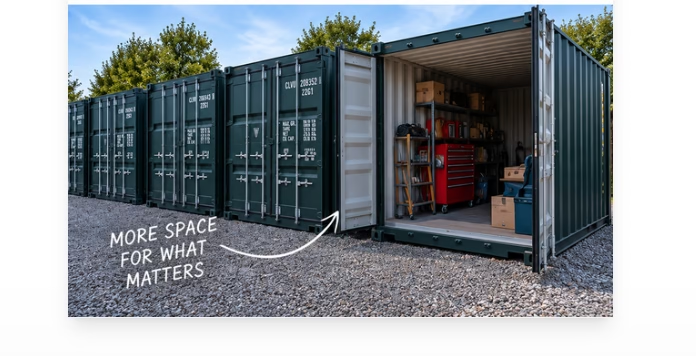
A shipping container could be the simple solution when you need a little more space

We delivered a 10ft shipping container this week to The Crafty Cockney Pie & Mash on Canvey Island. They’re a family run traditional East End

We get a lot of questions about refrigerated containers at C4S, from people who’ve never used one before right through to businesses that have had
Posted on GoogleTrustindex verifies that the original source of the review is Google. The only Most Way About c4sale Ltd Limited Edition In India and Europe And ViaPosted on GoogleTrustindex verifies that the original source of the review is Google. A pleasure to deal with from start to finish with Sam making the transaction as smooth as it could be. The container arrived on the day and was perfect for the job.Posted on GoogleTrustindex verifies that the original source of the review is Google. Excellent friendly service, highly recommended, pulse the delivery guys were so kind and helpful . Couldn’t be more grateful to use this company for my containers.Posted on GoogleTrustindex verifies that the original source of the review is Google. Very pleased with the service and was happy with the container thank you guysPosted on GoogleTrustindex verifies that the original source of the review is Google. As a business we have purchased 6 containers from Containers 4 Sale UK. I dealt with Josh from start to finish. He was helpful all the way through the process and kept me updated of ETA of delivery. Excellent service. If we need any more I will definitely be coming here.Posted on GoogleTrustindex verifies that the original source of the review is Google. Good customer service. Delivered when needed and in time. RecommendedPosted on GoogleTrustindex verifies that the original source of the review is Google. I cannot recommend Bobby from C4S highly enough. From start to finish, he provided exceptional service that truly exceeded our expectations. Bobby's communication was impeccable - he kept us informed every step of the way, ensuring we knew exactly when to expect our delivery. Not only did Bobby offer the most competitive price for our containers, but he also went above and beyond to ensure we were completely satisfied with our purchase. His attention to detail and dedication to customer satisfaction truly sets him apart. Our container needs were met seamlessly. We are incredibly impressed with the service provided and will definitely be contacting Bobby again for our next round of containers. If you're looking for a reliable, trustworthy supplier, look no further.Posted on GoogleTrustindex verifies that the original source of the review is Google. Hi there, we were recommended Containers 4 Sale by a friend, and I am so so glad we were. We purchased 3 containers which are now in situ, all was arranged by Bobby Addis who was extremely helpful, knowledgeable and polite. The haulage company arranging the drop were also extremely good. We have used other container companies but I would highly recommend Bobby over and above any other company. Thank you,Posted on GoogleTrustindex verifies that the original source of the review is Google. Good honest service, fair price, punctual delivery. I would happily recommend this company.Posted on GoogleTrustindex verifies that the original source of the review is Google. Had a 20 foot container delivered to our yard. Delivery was smooth and driver was ever so helpful, and the staff at Containers 4 sale were professional. Thanks to Josh for helping me through my order process.Load more
